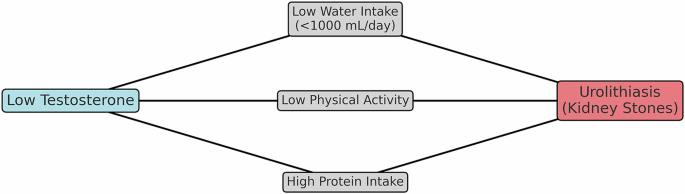
Older age and low testosterone levels are independently associated with kidney stone prevalence in men: results from a large cross-sectional study
Subjects
Data on men who participated in health checkups at one university hospital in Seoul, South Korea, during the period from 2010 to 2020 were collected.
Anthropometric measurements (height and weight), blood pressure measurements, basic blood chemistry, and lipid profile analyses were included in the basic health screening. Serum uric acid, hemoglobin A1c (HbA1c), high-sensitivity CRP (hs-CRP), and testosterone were measured, and plain-film kidney–ureter–bladder radiography (KUB) and abdominal ultrasonography were performed. Serum was drawn between 7:00 and 9:00 AM after overnight fasting. Medical histories were collected by trained nurses.
This study included men (aged ≥20 years) who simultaneously underwent blood collection, KUB testing, and ultrasound examination on the day of the basic health checkup. The exclusion criteria were as follows: patients who were receiving androgen replacement therapy (n = 15); participants who had any congenital renal deformities, polycystic kidney disease, dysgenesis or hypoplasia, renal cancer or renal tumor; or a kidney transplant (n = 2); and patients who were taking diuretics (n = 3). Finally, 3234 males were enrolled.
To evaluate the associations between serum testosterone levels and kidney stones, we examined the following variables: age, body mass index (BMI), blood pressure, triglyceride (TG), low-density lipoprotein cholesterol (LDL), high-density lipoprotein cholesterol (HDL), creatinine (Cr), blood urea nitrogen (BUN), HbA1c, uric acid, hs-CRP, calcium, aspartate transaminase (AST), alanine aminotransferase (ALT), albumin, testosterone and medical history.
Kidney stones
For stone detection, combined ultrasonography and KUB radiography was used. A comprehensive review of the literature showed that combining KUB with ultrasound improves the sensitivity compared to that of ultrasound alone, with estimates of sensitivity and specificity ranging from 58% to 100% and 37% to 100%, respectively [10].
KUB was taken immediately prior to ultrasonography, and investigators reviewed the KUB before performing ultrasonography. Nephrolithiasis was suspected when calcifications were identified along the anatomic course of the kidney on the KUB. The KUB was used to guide the radiologist to the area of suspected urinary calculi.
All of the ultrasonography examinations were performed by attending radiologists using an iU22 system (Philips Medical Systems, Amsterdam, Netherlands). B-mode ultrasonography was used to detect the stones by physically differentiating between stones and surrounding tissues. Bright echogenic structures with a nonechogenic shadow in the ultrasonographic image were considered to indicate nephrolithiasis. Small calculi (<3 mm) might not show acoustic shadowing. However, we did not include bright echogenic structures without a nonechogenic shadow in our definition of nephrolithiasis to ensure the inclusion of more clinically important renal stones [11]; this decision was made because in long-term follow-up studies, it has been reported that larger asymptomatic renal stones (>5 mm) are more likely to become symptomatic [12, 13].
Confounders
In previous studies, age [14], hypertension [14], BMI [14], dyslipidemia [15], renal function [16], uric acid [17], hs-CRP [18], HbA1c [19], and serum calcium [20, 21] were associated with urinary stones. Therefore, we adjusted for the aforementioned factors to elucidate the association between testosterone and nephrolithiasis.
Fatty liver disease is also a risk factor for nephrolithiasis. Accordingly, AST and ALT were adjusted as parameters of fatty liver disease in this analysis [22]. Additionally, high protein intake, which in turn increases serum albumin [23], is related to the development of nephrolithiasis [24]. Hence, the serum albumin level was adjusted as a parameter of high protein intake to elucidate the association between testosterone and nephrolithiasis.
Ethics approval and consent to participate
The Institutional Review Board of Nowon Eulji University Hospital reviewed and approved the study protocol (approval number: 2024-05-006). Participants voluntarily underwent health examinations at the health examination center and gave informed consent to the study. All authors confirmed that research involving human participants has been conducted ethically according to the principles of the World Medical Association Declaration of Helsink.
Statistical analysis
The primary aim of our study was to elucidate the relationship between serum testosterone levels and nephrolithiasis. The demographics were assessed using descriptive statistics. The cutoff point for testosterone as a discriminator of the presence of kidney stones was determined using receiver operating characteristic (ROC) curves, which enabled the calculation of the total area under the ROC curve and cutoff points with better sensitivity and specificity.
We used binary logistic regression to determine the associations between testosterone and nephrolithiasis before and after adjusting for all other variables. Odds ratios (ORs) with 95% confidence intervals (CIs) were calculated before and after adjusting for all confounders. All tests were 2-sided, with statistical significance set at P < 0.05. The R statistical package v.2.13.1 was used for analysis.
link