Finerenone versus spironolactone in patients with chronic kidney disease and type 2 diabetes: a target trial emulation
The study adhered to the ethical principles of the Declaration of Helsinki33 and followed the Strengthening the Reporting of Observational Studies in Epidemiology (STROBE) guideline. Ethical approval for this study was obtained from the Institutional Review Board of Chi Mei Hospital (approval number: 11210- E01). In addition, all participating healthcare organizations contributing data to the TriNetX Research Network had obtained institutional review board (IRB) or ethics committee approval to share de-identified data. The use of de-identified, aggregated data was deemed exempt from informed consent by the Western Institutional Review Board. This exemption is based on the TriNetX platform’s data de-identification process, which complies with the Health Insurance Portability and Accountability Act (HIPAA) Privacy Rule and General Data Protection Regulation (GDPR) standards. The data are formally certified by a qualified expert as de-identified, contain no protected health information (PHI), and are presented only as aggregated summaries, thus, the research is considered non-human subjects research and exempt from informed consent requirements.
Data source
This study used data from the TriNetX platform, which aggregates electronic health records (EHRs) from the Global Collaborative Network, comprising 146 healthcare organizations (HCOs). These HCOs span 21 countries across the Americas, Europe/Middle East/Africa (EMEA), and Asia-Pacific (APAC) regions, including the United States, United Kingdom, Germany, France, Israel, Japan, Taiwan, and Australia. The available EHR data include patient demographics (including sex as recorded in the individual’s EHR), diagnoses, medications, procedures, laboratory tests, genomics, visits, and details related to socioeconomic factors and lifestyle. Race and ethnicity are recorded separately in TriNetX, consistent with clinical documentation standards in the United States and other participating regions. This network encompasses both insured and uninsured patients from a range of clinical settings, including hospitals, primary care units, and specialty clinics34,35,36,37,38,39,40,41,42.
Target trial specification and emulation
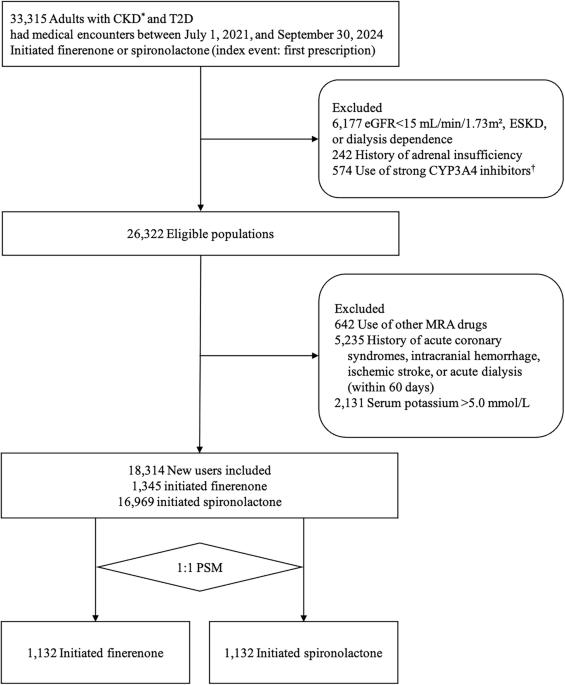
The target trial emulation framework was used to design and analyze this observational study, replicating an RCT structure using observational data43,44. This framework has been widely applied in clinical research, particularly in studies on CKD45,46. To emulate randomization, the finerenone and spironolactone groups were propensity-score matched for these covariates47. Details of the target trial specification, including eligibility criteria, treatment strategies, outcomes, and analysis approach, are provided in Supplementary Table 1 and Supplementary Fig. 1.
Eligibility criteria
The target trial emulation included adults aged ≥18 years with CKD and T2D who had medical encounters between July 2021 and September 2024. This study period was selected as finerenone was first approved by the US FDA in July 2021. Incident CKD was defined as two eGFR values < 60 mL/min/1.73 m², measured at least 90 days apart, using the Modification of Diet in Renal Disease Study (MDRD) formula. Patients were grouped based on the first prescription (new users) of either finerenone or spironolactone, marking the baseline or index event. Eligible patients had no history of either MRAs use in the preceding 6 months before index event. Exclusion criteria included prior eGFR values < 15 mL/min/1.73 m², end-stage renal disease (ESRD), or recent events such as acute coronary syndromes, stroke, cardiac arrest, cardiogenic shock, or ever dialysis within 60 days of the index prescription. Other exclusions included medical contraindications (e.g., adrenal insufficiency such as Addisonian crisis or history of strong CYP3A4 inhibitors) and safety concerns (e.g., hyperkalemia, defined as serum potassium ≥5.5 mmol/L, as per the safety warnings for either finerenone or spironolactone). Eligibility criteria and baseline covariates were evaluated during the baseline period, defined as the one-year period prior to the index event. (Supplementary Table 2 and Supplementary Fig. 1).
Treatment strategies
Two treatment strategies were compared: initiation of finerenone or spironolactone at baseline (index event). Treatment initiation was defined as the first prescription of the respective medication (new-user design), following an intention-to-treat approach, with no adjustments for medication adherence, switches, or addition of other MRAs.
Prespecified outcomes
The primary outcomes were major adverse cardiovascular events (MACE), major adverse kidney events (MAKE), and all-cause mortality. MACE was defined as acute coronary syndromes, nonfatal stroke, hemorrhagic stroke, cardiac arrest, cardiogenic shock. To complement our primary definition, we additionally evaluated alternative MACE definitions based on narrower myocardial infarction criteria. MAKE was defined as progression to end-stage kidney disease (ESKD) or initiation of dialysis. The secondary outcome was hyperkalemia, assessed at thresholds of ≥5.5 mEq/L. Each patient was followed from the index event until the occurrence of an outcome of interest, loss to follow-up, death, administrative censoring (March 14, 2025), or a maximum follow-up period of 1.5 years, whichever occurred first (Supplementary Table 3).
Covariates
The predefined covariates, selected based on clinical knowledge and previous evidence, were measured within 1 year before the index event to balance treatment group differences. These included sociodemographic factors—age, race, sex, and socioeconomic status—as documented in the electronic health record; laboratory and vital sign measurements (glycated hemoglobin, eGFR, blood pressure, total cholesterol, low-density lipoprotein cholesterol, body mass index, and potassium); medications (insulin, metformin, glucagon-like peptide 1 receptor agonists, sodium-glucose cotransporter 2 (SGLT2) inhibitors, renin-angiotensin system (RAS) inhibitors, β-blockers, calcium channel blockers, aspirin, anticoagulants, and hydroxymethylglutaryl-CoA (HMG-CoA) reductase inhibitors); comorbidities (ischemic heart disease, heart failure, hypertension, cerebrovascular disease, peripheral vascular disease, atrial fibrillation and flutter, acute kidney injury, anemia, chronic obstructive pulmonary disease, liver disease, systemic connective tissue disorders, neoplasms, hyperuricemia, sleep apnea, depressive episodes, and anxiety disorders); diabetic complications (ophthalmic, neurologic, and circulatory); and lifestyle factors (nicotine dependence and alcohol-related disorders) (Supplementary Table 4).
Statistical analysis
To minimize confounding and emulate the randomization process, one-to-one propensity score matching (PSM) was performed using logistic regression with greedy nearest-neighbor matching and a caliper width of 0.1 pooled standardized differences42. Adequate balance between the matched groups was considered achieved when the standardized difference was less than 0.1, indicating minimal differences48. To address missing laboratory data (e.g., BMI, HbA1c, SBP, lipids, and UPCR), we included a distinct “no measurement” category for each variable in the propensity score model.
For the primary analysis, hazard ratios (HRs) and 95% confidence intervals (CIs) were estimated using Cox proportional hazards models under an intention-to-treat framework. Cumulative incidence curves were generated using the Kaplan-Meier method, and differences were evaluated with the log-rank test. Absolute risk reduction (ARR) was calculated as the difference in event rates between groups, and number needed to treat (NNT) was derived as its reciprocal (NNT = 1/ARR). Confidence intervals for ARR and NNT were estimated using standard binomial methods. The incidence of hyperkalemia was assessed using odds ratios (ORs) with corresponding p values, which were derived from the chi-square test. To assess robustness to unmeasured confounding, we calculated E-values, with higher values indicating greater resistance to bias49.
Predefined subgroup analyses were conducted in separate PSM cohorts stratified by clinically relevant baseline characteristics, including age, sex, glycated hemoglobin level, baseline eGFR, proteinuria, heart failure, and use of SGLT2 inhibitors and RAS inhibitors, and enrollment year, to examine potential effect modification. To assess treatment persistence, we calculated the proportion of patients with ongoing prescriptions at 6 and 12 months after initiation. As a sensitivity analysis, we performed landmark analyses at these timepoints, including only patients who were event-free and remained on treatment to examine the associations with subsequent outcomes. Additional analyses included conducting analyses before propensity score matching (PSM), excluding events within 30 days of treatment initiation to reduce misclassification bias, and limiting dose-specific analyses to participants with recorded drug doses. To minimize bias from treatment switching, patients who transitioned to the alternative medication class were excluded. We also restricted analyses to patients with complete laboratory data to assess the impact of missingness. A negative control outcome analysis was performed by examining the association between treatments and overall cancer incidence, for which no association was expected50,51,52,53. To avoid bias associated with the interpretation of composite endpoints, we further conducted specificity analyses on the individual components of the outcomes of interest.
All analyses were conducted using the TriNetX platform (TriNetX LLC, Cambridge, MA, USA) and R software (version 4.4.1; The R Foundation for Statistical Computing, Vienna, Austria). A two-sided p value < 0.05 was considered statistically significant. Data were collected and analyzed from March 14, 2025, to April 30, 2025.
Reporting summary
Further information on research design is available in the Nature Portfolio Reporting Summary linked to this article.
link